Top senior-friendly cell phone plans and tips to choose

Staying connected is, no doubt, an important part of everyday life, even for seniors. However, choosing the right cell phone plan can feel confusing for older adults, given the long list of carriers, their features, and price points to compare. The ideal plan should be affordable and provide reliable coverage in the areas where one spends most of one’s time. With a little guidance and understanding of personal needs, one can easily narrow down the options and find a plan that truly fits. Tips to choose the best cell phone plan for seniors Check the coverage and signal quality When picking a mobile service for seniors, one can start by checking which carrier offers the best coverage. After all, a plan is only useful if calls connect clearly and internet speeds remain stable. Thankfully, most carriers make it easier for users to check where they provide coverage and where they don’t through coverage maps. One can simply log in to a carrier’s website, go to their resources section, and click the coverage maps option. These maps show whether an area receives strong 5G or basic 4G service. They also reveal weak spots, which are common in rural or hilly regions. These websites even allow users to enter an address, which makes it easier for them to check whether a carrier offers coverage in a particular area. Apart from that, one can also ask the seniors’ neighbors which carrier they use and whether it provides optimal coverage.  Determine their needs The next thing to consider when picking a cell phone plan for seniors is their personal usage and requirements. Some individuals, for instance, like having data coverage on their phones to stay connected to the internet. And some only prefer using their phones for calling and texting. Either way, it is helpful to have a simple conversation with them about daily usage before picking a plan.
Read More

Top senior-friendly cell phone plans and tips to choose

Things to consider when choosing internet-only plans

Most telecom companies offer homeowners bundled internet packages. These packages include not only an internet connection but also TV cable streaming, a phone line, OTT subscriptions, security software, and cloud storage. While these all-inclusive bundles have benefits, they’re not for everyone. Those who need just reliable internet for streaming, work, and calls, and nothing more, can buy standalone internet plans from their provider. What to consider when choosing standalone internet plans Internet-only plans are more affordable. They are also a smarter choice for those who already have access to TV streaming, OTT subscriptions, and other services included in bundles. Still, researching thoroughly and considering a few factors when buying a standalone internet plan is important. Speed and usage patterns The internet speed individuals need depends on their usage. Casual web browsing and sending and receiving emails require far less power and bandwidth. So, a slower plan can suffice in this case. However, 4K streaming, video conferencing, and gaming require a fast connection to prevent buffering and lag. Type of internet connection The internet can be delivered to homes with either coaxial or fiber optic cables. Coaxial cables use a slightly older technology that offers lower speeds. Fiber cables, on the other hand, are much more advanced, capable of delivering high speeds and lower latency. Individuals can also go in for wireless internet, especially in areas with limited wired infrastructure. Wireless connections may vary in network strength and consistency. Availability and local coverage Not all internet providers serve every neighborhood. Finding out which providers operate nearby can save time when searching for reliable, cheap internet providers. However, individuals should note that even if they find a good telecom company willing to provide a connection to their home, network quality can vary depending on local infrastructure and congestion levels. Reliability and network performance Frequent outages, slowdowns during peak hours, and unstable connections can disrupt work, streaming, and other online activities.
Read More
Things to consider when choosing internet-only plans

Top 6 mobile carriers offering phones for switching

Smartphones that have powerful processors, high-resolution multi-lens camera systems, and innovative foldable displays are often expensive. Fortunately, many carriers offer promotions to make these devices more accessible. Switching deals is among the most common. Here, carriers give customers a new phone for free or for a discounted price when they switch from another carrier and buy a qualifying plan. Such switching deals are often combined with other offers, such as trade-ins and installment plans. iPhone 17 Pro with AT&T The Apple iPhone 17 Pro is available for $0 per month with an eligible trade-in and a qualifying unlimited plan at AT&T. To qualify for the deal, users must trade in an iPhone 14 Pro Max or newer (excluding the 16e) and agree to a 36-month installment plan. If a user switches mobile carriers, the deal offers up to $800 to cover the previous carrier’s contract fees. Those who purchase a new line online receive $200 off. Beyond the smartphone, customers can add an Apple Watch SE 3 or an iPad for just $0.99 per month. The iPhone 17 Pro features the A19 Pro chip, triple 48MP cameras, and a durable aluminum unibody design. iPhone 16 with Verizon In addition to other mobile carrier discounts, Verizon offers the iPhone 16 for $0 per month on a 36-month installment plan for well-qualified customers. The deal is excellent, especially because it does not require a trade-in and offers free shipping. That said, customers must pay a $40 one-time activation fee per device. The plans range from $65/mo for the Verizon Unlimited Welcome plan to $90/mo for Unlimited Ultimate. As for the phone’s features, the iPhone 16 comes with a durable Ceramic Shield, aerospace-grade aluminum, and the new Super Retina XDR display. Google Pixel 10 with T-Mobile T-Mobile is offering the Google Pixel 10 128GB for as low as $0 (via bill credits) when users trade in an eligible device.
Read More
Top 6 mobile carriers offering phones for switching

LATEST Articles

5 no-contract carrier plans to consider

5 no-contract carrier plans to consider

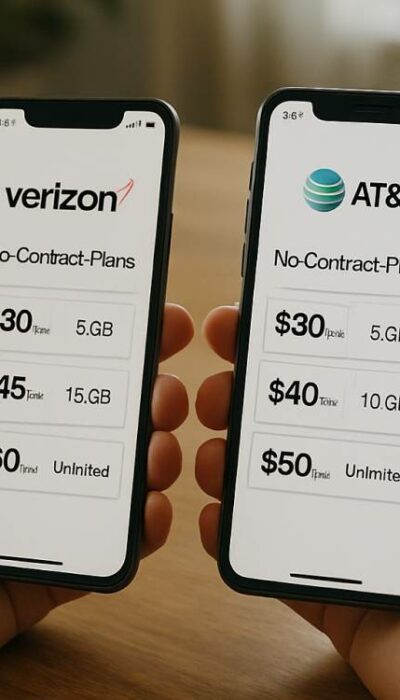
Network carriers provide a variety of mobile plans to suit different users. This includes options for those who prefer no-contract plans, even if they cost slightly more. While many top prepaid plans require no contract, not all are the same. Each plan offers a unique set of benefits, such as calling minutes, text messages, and data allowances. Learning about these differences can help one make a more informed choice when selecting a plan. US Mobile’s Unlimited Flex plan – Affordable for a single line The plan comes with 10 GB of high-speed data, followed by unlimited data at reduced speeds. Users also get 5 GB of hotspot data. The Unlimited Flex Plan also supports international calling and texting within the nation, with optional roaming add-ons while traveling. In terms of pricing, users can get this no-contract mobile deal for about $17 per month with an annual purchase (or $25 per month), making it a budget-friendly option for those with light data needs. Google Fi Unlimited Standard – For multiple lines Families seeking an affordable, no-contract cell plan that is also reliable can consider the Unlimited Standard plan from Google. This plan includes unlimited data, calls, and texts, with 50 GB of high-speed data. After reaching this limit, speeds slow down to 256 kbps. Additionally, the plan offers 25 GB of high-speed hotspot tethering and unlimited texting to over 200 destinations. The Google Fi Unlimited Standard plan is perfect for a family of four, and costs around $50 per month for four lines. Metro by T-Mobile Unlimited 5G Data – For bundle benefits At $60/month (with AutoPay), the Unlimited 5G Data prepaid plan provides unlimited 5G data, talktime, and text messages. Users can also get the plan for $140 if they take four lines, part of a fourth-line-free deal. There’s also an additional 25 GB of hotspot data and high-speed usage up to 70 GB before the speed is throttled.
Read More
AI texting platforms – Key features and top options

AI texting platforms – Key features and top options

From coordinating promotional campaigns to maintaining ongoing client communication, tracking engagement metrics, and ensuring compliance with communication standards, marketing teams handle various aspects of a business’s brand management. With so many tasks to manage, many of these teams find it difficult to keep up with customer updates. This is where automated AI tools for texting help. In brand marketing and customer relations, texts have proven to be more effective than emails. Key Features of AI Texting Tools AI texting tools let businesses personalize marketing communication by accessing customer data. This means the algorithms on these platforms analyze customer data, such as past purchases, behavior, and preferences, to recommend specific products in follow-up messages. An approach like this usually makes the message feel more relevant to each recipient. Also, these tools include automation that can be used to schedule the sending of messages according to optimal times determined by data patterns. Any incoming message related to frequently asked questions receives an instant response from a chatbot. This feature helps reduce the risk of manual oversight in regular interactions. In addition, most AI texting tools have two-way conversation capabilities. This helps teams to manage ongoing queries directly through text. Customers receive prompt replies, which turns the conversational SMS into a dedicated support channel. With these features, businesses can maintain consistent customer engagement at all times. Popular Platforms at a Glance Attentive For businesses looking for an AI-powered platform for SMS and email marketing, this is a good option to consider. It offers one-on-one experiences by capturing, storing, and activating customer data across SMS, RCS, and email. Some of its notable features include advanced segmentation to identify audience sizes and preferences, and A/B testing for customer flows like abandoned carts. Pricing varies from business to business, as it depends on a customized enterprise model tailored to the company’s size.
Read More